E-Wallet Forex Trading Q3 2026: Why Speed Wins
E-wallet forex trading in Q3 2026 demands speed. With central banks diverging and oil above $100, instant deposits beat 5-day bank wires every time.
E-wallet forex trading in Q3 2026 demands speed. With central banks diverging and oil above $100, instant deposits beat 5-day bank wires every time.

The macro picture: The ECB has begun hiking rates for the first time since 2023. A new, hawkish Fed chair took office in May. The Bank of England is split on its next move. And oil is back above $100 a barrel (roughly €92) as the Strait of Hormuz disruption deepens.
What this means for your trading: Currency pairs are swinging on every central-bank headline and every oil-price tick. The difference between catching a move and watching it pass is measured in minutes, not days.
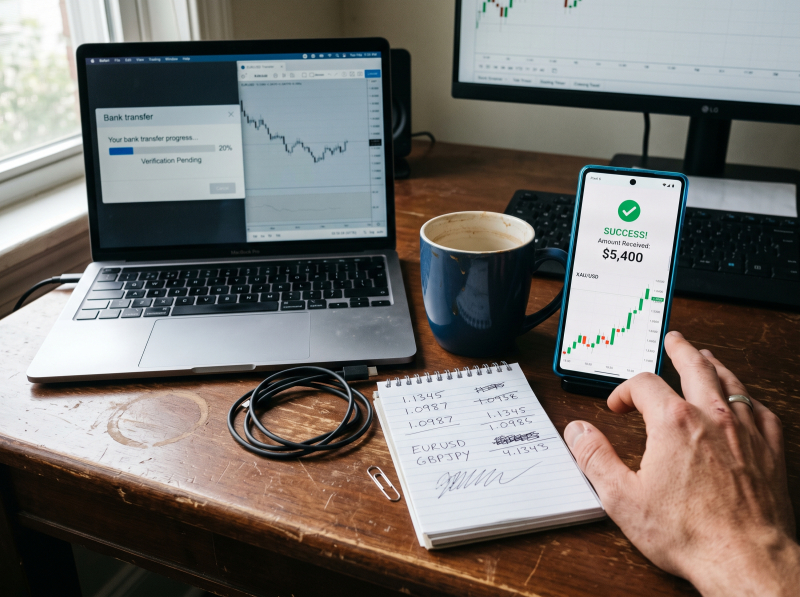
The payment gap: Bank wires still take 3 to 5 business days to settle. E-wallet deposits are instant. In Q3 2026, that gap is the difference between trading the move and reading about it afterward.
Open your Skrill account through Wikiwallet today, become a Silver VIP, and claim your $35 welcome bonus (roughly €32). Your account is upgraded within 24 hours.
Last updated: July 2026
Central bank divergence is the main story. Three major economies are heading in three different directions.
The Federal Reserve under new Chair Kevin Warsh turned hawkish fast. At his first FOMC meeting on June 16-17, rates held at 3.50-3.75%, but nine of nineteen officials penciled in rate hikes by year-end - up from zero in March. Warsh eliminated forward guidance and shortened the policy statement to roughly 130 words. The dollar posted its largest single-day gain of 2026 after that meeting. State Street’s July 2026 currency commentary noted the dollar “ranked high” on its scorecard but is “losing momentum.”
The European Central Bank hiked 25 basis points in June 2026 - its first increase since September 2023 - taking the deposit rate to 2.25%. It held in July, but roughly 70% of economists surveyed by Reuters expect another 25bps in September. As IFX Payments noted in their Q2/Q3 FX briefing, the ECB faces a stagflation mix: inflation near 2.8% against GDP growth of just 0.8%.
The Bank of England is internally divided. The MPC held at 3.75% in June in a 7-2 vote, with hawks Pill and Greene dissenting. The July 30 decision is expected to repeat that split. Services inflation remains sticky at 3.7% while unemployment rises toward 4.9% - a combination that pulls the committee in opposite directions.
And then there is oil. Brent crude round-tripped from roughly $120 a barrel (roughly €110) in April down to $72 (roughly €66) in late June after a brief U.S.-Iran MOU - then shot back above $100 (roughly €92) by late July as the agreement collapsed. The U.S. Strategic Petroleum Reserve sits at its lowest since 1983, at 316.5 million barrels. State Street described the likely outcome as “a choppy, rangebound currency market.”
For currency pairs, the LSEG FX Forecast Poll for July 2026 shows the GBP/USD 3-month mean falling from 1.3397 to 1.3281 and EUR/USD downside risk widening to a 12-month low of 1.0500. Three major rate decisions - ECB July 23, Fed July 29, BoE July 30 - landed within eight days of each other.

The bank-wire problem has not changed. The cost of that problem has.
A SWIFT bank wire still takes 3 to 5 business days to settle. In that window, a major currency pair can move 0.5% to 2% - a material swing for any leveraged position. The real cost is not the visible wire fee ($15-30, roughly €14-28). It is the opportunity cost of capital frozen in transit during a central-bank announcement or an oil-price spike.
During the June FOMC meeting alone, the dollar surged and equity markets fell sharply within hours. A trader waiting for a wire missed the entire session. The hidden cost stack for regular international transfers - FX markup at the bank (2-4%), intermediary lifting fees, and float during settlement - can add up to thousands per year. Our guide to e-wallet fees breaks down how these costs compare across payment methods.
To put it simply: when three central banks decide rates in the same eight-day window and oil swings $20 in either direction, a five-day payment method is a competitive disadvantage. E-wallets solve this.
If you are funding a trading account this quarter, opening your Skrill account through Wikiwallet puts you at Silver VIP with a reduced qualification threshold (€5,000 instead of €15,000). Lower fees from your first trade, and your account is upgraded within 24 hours.
Skrill and Neteller deposits to supported forex brokers arrive instantly. Independent 2026 testing clocks Neteller deposits at 8 to 15 seconds via mobile app. Skrill funds appear within seconds. Bank wires to the same brokers take 3 to 5 business days. Withdrawals via e-wallet clear within hours to 24 hours, compared with days for bank wires.
Say you are watching EUR/USD during the July 23 ECB decision. With Skrill, you fund your broker, enter the position, and manage the trade - all within the same session. With a bank wire, you started the transfer days earlier and still had no guarantee of cleared funds when the announcement hit.
E-wallets also function as a central funding hub. You maintain one balance and deposit to multiple broker accounts without separate bank transfers for each - useful if you split capital across brokers for regulation or spread comparison.
There is a privacy advantage too. Your banking and card details are never exposed directly to your broker. Skrill and Neteller both operate under Paysafe Group, regulated by the FCA, with 256-bit SSL encryption and two-factor authentication. For a full side-by-side comparison of how these wallets stack up for trading, read our Skrill vs Neteller vs LuxonPay breakdown.

Skrill has the broadest broker acceptance in the industry. It is supported by eToro, XM, XTB, FXTM, Exness, and most other major platforms. Through Wikiwallet, you start at Silver VIP: the quarterly qualification threshold drops from €15,000 to €5,000, you claim a $35 welcome bonus (roughly €32), and your account is upgraded within 24 hours. Skrill is the better first choice simply because more brokers accept it.
Neteller runs on the same Paysafe infrastructure with similarly wide broker acceptance. Through Wikiwallet, the Silver VIP threshold drops from $15,000 to $6,000 (roughly €5,500), and the FX conversion fee drops from 3.99% to 3.19%. That difference matters when you move funds between currencies. Open your Neteller account through Wikiwallet for a $35 bonus (roughly €32) with activation within 24 hours.
LuxonPay is built around multi-currency wallets. Through Wikiwallet, the Noir VIP tier drops from €30,000 quarterly volume to just €500, with a $30 bonus (roughly €27). Broker acceptance is more limited than Skrill or Neteller, however. It is the right choice only if your specific broker supports it. Check if LuxonPay fits your setup.
Many experienced traders maintain both a Skrill and a Neteller account as an instant backup. Open your Skrill account through Wikiwallet today, start at Silver VIP, and claim your $35 bonus.
Yes. Independent 2026 testing confirms Skrill and Neteller deposits to supported brokers appear within seconds. Neteller clocks 8 to 15 seconds via mobile app. Skrill funds appear within seconds. Withdrawals are slower (hours to 24 hours) but still far faster than bank wires, which take 3 to 5 business days either way.
The main cost is FX conversion. If your wallet and broker currency differ, standard FX markup is 3.99%. Through Wikiwallet VIP, the Neteller FX fee drops to 3.19%. Some brokers charge their own deposit fee - XTB charges 2% for Skrill, 1% for Neteller, while eToro and Exness charge nothing. Check both sides before funding. Our unbiased guide to e-wallet fees covers the full picture.
Only if your specific broker supports it. LuxonPay’s broker acceptance is more limited than Skrill or Neteller. If your platform does support it, LuxonPay offers strong multi-currency features and a significantly reduced Noir VIP entry threshold through Wikiwallet (€500 instead of €30,000).
Bank wires take 3 to 5 business days. In Q3 2026, with three major central banks deciding rates within eight days and oil swinging on geopolitical headlines, that delay means missing the trade entirely. Bank wires also carry intermediary fees (roughly €14-28 per transfer), bank-level FX markups (2-4%), and capital frozen in transit.
Q3 2026 is not a normal quarter for forex. A new Fed chair has rewritten the rulebook on forward guidance. The ECB is hiking for the first time in nearly three years. The Bank of England is split. Oil is back above $100 with no clear end to the Hormuz disruption.
In this environment, payment speed is not a convenience - it is a competitive necessity. Bank wires leave capital in limbo for days. E-wallet deposits put you in the trade in seconds.
When you strip it all away, Q3 2026 rewards traders who can move capital instantly. Whether you are trading EUR/USD through the ECB cycle, positioning for sterling volatility around the BoE, or watching oil-sensitive pairs, an e-wallet funded through Wikiwallet gets you into the market faster, with lower VIP fees, and a backup funding route when you need it. Open your Skrill or Neteller account through Wikiwallet today.
Compare Skrill and Payz to see which offers more value in 2025. Skrill and Payz are two of the most popular options when choosing an e-wallet for gambling, poker, or forex trading. Both provide secure transactions, multi-currency support, and fast transfers. However, their differences in fees, p...
Avoid High Fees and Unlock Exclusive Benefits. Stop losing money to high fees. Discover how Skrill and Neteller VIP can transform your gaming and trading experience! Stop letting high fees drain your hard-earned money. If you're a gamer cashing out winnings or a trader moving funds, those extra ...
Deposit more than 5 thousand EUR/USD to your AstroPay account and use it for financial trading, and you will be eligible for 1% cashback in Brazil. Forex is one of the most lucrative and growing online activities in Brazil that is turning many average households into newly wealthy Brazilians...
Want to earn extra cash effortlessly? Take advantage of the NETELLER 0.5% Cash Bonus promotion in Brazil until the 11th of April! When you deposit funds into your NETELLER account using Pix, Brazil's most widely used payment method, you'll receive a 0.5% Cash Bonus. This is a fantastic opp...

Donate your question and we’ll provide an answer. Together we can make this community smarter!


