Skrill Neteller Fake App Malware July 2026: Check Now
A malware campaign impersonating Skrill and Neteller hit npm and PyPI on July 7, 2026. Is your wallet safe? Here are the five security checks to run now.
A malware campaign impersonating Skrill and Neteller hit npm and PyPI on July 7, 2026. Is your wallet safe? Here are the five security checks to run now.

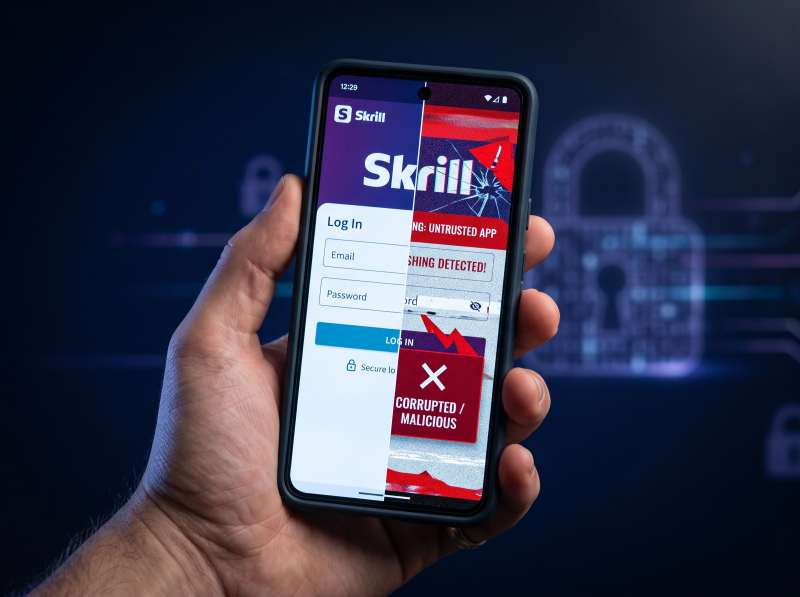
On July 7, 2026, security researchers at Socket uncovered a coordinated malware campaign - 17 fake packages on npm and PyPI impersonating official Paysafe, Skrill, and Neteller developer tools. If you use Skrill or Neteller, you are probably wondering: is my money safe, and what do I need to do? The short answer: this attack did not breach Skrill or Neteller servers. No account balances or personal data were accessed. But it signals something worth your attention - and there are specific steps you should take now.
Last updated: July 2026
Attackers published fake packages with names nearly identical to real ones - skrill, skrill-sdk, skrill-payments, neteller - on npm and PyPI, the two largest developer code-library platforms. When a developer mistyped a package name during installation, they pulled in the fake version.
The packages looked legitimate, mimicking payment API functions and returning fake “success” responses so nothing appeared broken. Behind the scenes, they harvested credentials - API keys, AWS secrets, GitHub tokens, npm tokens, any environment variable containing KEY, SECRET, TOKEN, PASS, AUTH, or API. Stolen data was sent to a command server behind an ngrok tunnel, on AWS infrastructure with prior NjRAT malware links, according to Socket’s original disclosure.
Socket’s AI scanner detected all 17 packages - 13 on npm, 4 on PyPI - within six minutes of publication. Fast, but live long enough for downloads to occur. Heal Security, in its July 9 analysis, noted the Python packages were “arguably more dangerous, since they could trigger data theft even in testing environments.”
No. This attack did not breach Skrill or Neteller servers. Your wallet balance, transaction history, and KYC documents were not accessed.
The nuance is supply-chain risk. If a developer at a trading platform or payment processor you use installed a fake package, that service’s credentials could have been stolen - exposing your data there, even though your Skrill or Neteller account was never directly targeted. It is not your wallet being hacked, but it is the indirect risk worth understanding.
The broader trend makes this worth your attention. In 2025, over 1 million online banking accounts were compromised by infostealers, according to Kaspersky. Mobile banking trojan attacks grew 50 percent year over year. One in 20 verification attempts is now flagged as fraudulent, per Zimperium. Financial malware is not slowing down - and e-wallet brands are increasingly in the crosshairs.
For more on how providers handle security incidents, read our guide on what happens when an e-wallet detects unusual account activity - in most cases, freezes are protective, not arbitrary.
These five checks take less than ten minutes and close the most common entry points for account compromise.
Verify you have the real app. On Android, the official Skrill app is published by Paysafe Holdings UK Limited, package ID com.moneybookers.skrillpayments. Neteller is from the same developer, package ID com.moneybookers.skrillpayments.neteller. On iOS, look for “Skrill - Pay & Transfer Money” and “Neteller - Money Transfer.” If you downloaded from anywhere other than Google Play or the Apple App Store, delete it and reinstall from the official store.
Never sideload e-wallet apps. Any “Download APK” link claiming to be Skrill or Neteller is fake. The real apps are distributed only through official app stores. There is no exception to this rule.
Turn on two-factor authentication. Both Skrill and Neteller support 2FA - enable it in your account settings. Even if your password is ever exposed, 2FA blocks unauthorized logins.
Review your account activity. Log in and check your last 30 days of transactions and login sessions. Look for anything you do not recognize - even small test amounts. If you spot something, contact support through the official website by typing skrill.com or neteller.com directly into your browser. Never reach support through a search result or an email link.
Watch for phishing after the news cycle. Major security incidents trigger copycat phishing campaigns. Expect emails claiming to be from “Skrill Security Team” asking you to “verify your account following the recent breach.” Skrill and Neteller will never ask for your password or 2FA code via email. Navigate directly to the official website - do not click links in unsolicited messages.
This is not isolated. In 2025, 34 banking malware families targeted over 1,200 financial brands across 90 countries, affecting apps with more than 3 billion combined downloads, per Zimperium. And 74 percent of payment cards compromised by infostealers remained valid months later, according to Kaspersky’s 2026 data. Typosquatting alone remains the dominant npm attack vector: one campaign published 176 malicious packages in a single day in May 2026, as reported by OffSeq and the Cloud Security Alliance.
The takeaway is not that e-wallets are unsafe. They are secure when you use them through official channels with basic hygiene. The risk lives in third-party tools, fake apps, and phishing - not in the e-wallet infrastructure itself. When you sign up through Wikiwallet, you deal with the real service, the real app, and real VIP benefits - no shortcuts, no sideloaded APKs, no mystery packages.
EU consumer protections for e-wallet accounts are also strengthening. Our breakdown of the new MICAR regulation covering Skrill and Neteller explains the specific safeguards now required under EU law.
The smartest security move is starting with a verified account. When you open Skrill through Wikiwallet, you unlock Silver VIP at €5,000 instead of the standard €15,000 - plus a $35 (roughly €32) welcome bonus, free P2P transfers, free ATM withdrawals, and a free prepaid MasterCard. Your account is upgraded within 24 hours, and cashback is credited automatically on the 8th of every month.
For Neteller, opening through Wikiwallet drops the Silver threshold to $6,000 (roughly €5,500) from the standard $15,000 (roughly €13,700), with the same $35 bonus and premium support.
After the July 2026 malware campaign, starting with a fully verified, VIP-upgraded e-wallet is the simplest security upgrade you can make today.
Open your Skrill account through Wikiwallet and claim your $35 welcome bonus - or become a Neteller VIP with the same reduced-qualification path.
You find a forex broker with a solid welcome bonus. You sign up, verify your account, and fund it with Skrill - only to discover the bonus is gone. The fine print excluded e-wallet deposits. This is not a rare edge case. Here are six brokers where the welcome bonus survives a Skrill or Neteller ...
Every deposit, withdrawal, card swipe, and crypto trade you make on Skrill could be earning you cashback. But most Skrill account holders never activate the program that pays it. Skrill Knect is a free loyalty programme that turns transactions you are already making into redeemable points - and it ...
You closed a profitable trade. Now you are waiting for your money. Bank wires crawl through correspondent banks for 3 to 5 business days. Debit card withdrawals are not much faster. Every hour your capital sits in limbo is an hour it is not working for you. This is the gap e-wallets close. A Skr...
Most broker lists skip the deposit fee. We checked 12 forex brokers. Here is who charges zero for Skrill and Neteller funding, and who quietly takes a cut - unbiased, per-broker breakdown. Most “Skrill forex brokers” lists tell you whether a broker accepts the wallet. Sites like ForexDominion list...

Donate your question and we’ll provide an answer. Together we can make this community smarter!


